
Running Injury Treatment - Spokane, WA
Reviewed By: Stephen Byers, DC CSCS
ROCK YOUR RUN
Get Back to Running Strong Again
Rock Your Run is a complete diagnostic and recovery program for Spokane runners — built around one question: is your running form causing your pain, or is your pain affecting your running form? We find the answer with data, then build the plan that gets you back on the road or trail and running strong again.
The Problem Most Running Care Misses
Running pain usually isn't coming from where you've been told to look
Most running-related pain gets treated one of two ways: as a form problem (more drills, new shoes) or as a body problem (rest, ice, stretching). Both can be part of the picture. But neither one answers the question that actually matters — can your body physically do what your stride is asking of it?
A running coach can tell you what your gait should look like. Imaging can rule out structural damage. Neither one tells you whether you have the mobility, the stability, the strength, and the firing sequence to absorb impact, propel yourself forward, and stay healthy mile after mile.
That's the gap Rock Your Run was built to close. We assess your body and your stride together, figure out which one is driving the pain, and build the plan around the answer.
Who It's For
Built for Spokane runners at every level
Rock Your Run is for runners dealing with hip pain, IT band syndrome, runner's knee, shin splints, or plantar fasciitis — whether it's a recent flare-up or something that's been nagging across training cycles.
It's also for runners who aren't in acute pain but keep hitting the same physical limitations: the hip that won't extend, the foot that collapses on landing, the calf that's always one run away from going.
You don't have to be a competitive racer to benefit. We work with weekend joggers, recreational runners, road racers, trail runners, and a handful of serious amateurs. The program scales to wherever you are and whatever you want from your running — whether that's getting through your weekly mileage without pain or rebuilding the physical foundation your stride depends on.
If you're not sure whether your situation fits, that's exactly what the first visit is for.
What's Included
A complete clinical recovery program for runners
01
FULL MOVEMENT ASSESSMENT
Every program starts with a Movement Assessment — a full-body evaluation of your mobility, stability, strength, and movement patterns, not just the area that hurts. This reveals the physical limitations that may be feeding into your problems on the road or trail.
02
RUNNING-SPECIFIC BIOMECHANICAL TESTING
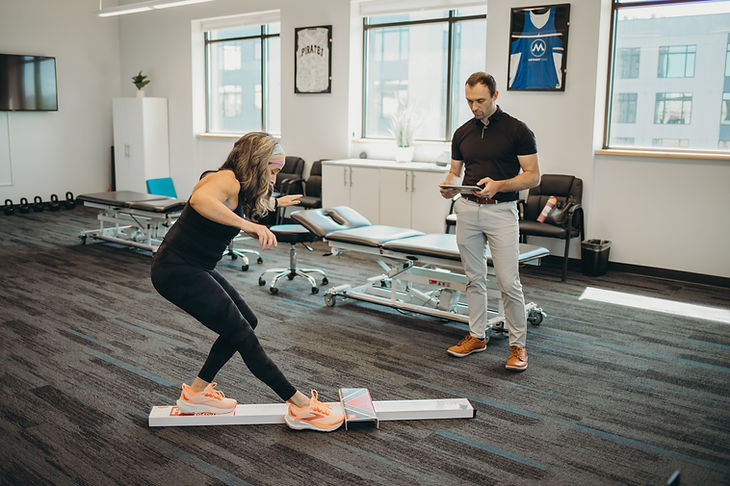
We assess your strength, power and gait mechanics through our biomechanics testing to see how your physical limitations connect to your running pattern. Understanding whether pain is coming from physical restrictions, running mechanics, or both shapes everything that comes next.
03
SPORTS CHIROPRACTIC CARE
Targeted sports chiropractic adjustments restore motion to stiff joints and reduce irritation in the affected areas. Soft-tissue treatment helps release tight muscles and calm down the pain so you can move and train.
04
RUNNING-SPECIFIC REHABILITATION
We use targeted exercise to wake up the areas of your body that have been too locked up to work properly, then strengthen them so the problem doesn't come straight back. This is the part that makes the results stick. Your patient account will give you access to our self-help videos to review how to do your exercises properly at-home.
05
RETURN TO TRAINING PLANNING
We use our Rock Your Run training guide to show you how to warm up, rebuild mileage, and manage your training load — so you can stay in the game, not just recover from this stretch of it.
Total Investment: Estimated to be $309 to $750 depending on your medical insurance coverage. Typically medical insurance covers the initial Movement Assessment, sports chiropractic care and any running-specific rehabilitation.
What Makes it Different
Why this isn't just sports chiropractic for runners
It's diagnostic, not just therapeutic. Most clinics treat what hurts. We focus on understanding why it hurts — by looking at how your body and your stride interact.
The biomechanics testing is the differentiator. No other Spokane sports chiropractor combines our movement assessment with professional biomechanics and gait-testing. This is what lets us answer the body-vs-mechanics question with data, not assumptions.
It's built around getting you back to your routine. Every part of the program is structured to leave you with a plan you can run on your own. We're not in the business of keeping you the same.
It works alongside your coach. If you have a running coach, the data from your biomechanics testing helps inform their work too. We're a complement to coaching, not a replacement for it.
Common Question
Will this help me run faster, or just without pain?
The honest answer is that this is a clinical program, not a performance program. The goal is to address the pain and physical limitations that are getting in the way of your training.
That said, when we restore the mobility, stability, and movement patterns your stride requires, many runners do find performance benefits. They're more comfortable, more efficient, and able to train more consistently. Whether that translates into faster times depends on a lot of factors that live outside the clinic — your training plan, your mileage, your nutrition, the time you put in. We're focused on the part we can actually help you with.
If your physical limitations are the bottleneck, we'll address those. If your training mechanics are the primary issue, we'll tell you that and recommend continuing work with a coach.
What to Expect
Realistic recovery timelines
Every runner is different, but here's what we typically see based on the nature of the issue.
6-8 VISITS
Acute Flare-up
Recent onset, first-time issue. Fast response with the right treatment and activity modification
4-8 WEEKS
Persistent or Recurring Pain
Pain that has been present for weeks or months, or keeps coming back. Requires addressing the underlying movement dysfunctions.
8-16 WEEKS
Performance Rebuild
Full recovery requires building the necessary mobility, strength and running mechanics needed to stay pain-free for the long term.


Frequently Asked Questions
Questions runners ask us about our Rock Your Run Recovery Program
Q: Do I need to be injured to do this program?
A: Not necessarily. Many runners start the program because they're recovering from something that didn't fully resolve, dealing with recurring flare-ups, or noticing physical limitations that are affecting their training. The Movement Assessment will help clarify where you are and what makes sense from there.
Q: How is this different from working with a running coach?
A: A running coach diagnoses and improves your training and form. We diagnose and address the physical side — your mobility, stability, and any limitations affecting how your body moves during your stride. The two work together, and the data from our biomechanics testing can give your coach better information to work with.
Q: Is the biomechanics testing covered by medical insurance?
A: No. The biomechanics testing is a cash service ($149). Most patients use insurance for the movement assessment, sports chiropractic, and rehabilitation portion of care.
Q: Will you tell me what shoes to run in?
A: To a point — but footwear isn't the focus. Our gait analysis can show how your foot is loading and where your stride breaks down, and that can absolutely inform a smarter shoe conversation. But a shoe is a tool, not a fix. If your foot is collapsing because of a mobility or strength limitation, a different shoe might mask it for a while — the program is built to address the limitation itself. We'll give you honest guidance on whether footwear is part of your picture.
Q: What if I'm not sure I need the full program?
A: Start with the Movement Assessment. It gives you a clear medical picture of your situation, and you'll leave with a real understanding of whether the full Rock Your Run program is the right fit — or whether something smaller makes sense. You're not committing to anything else by booking it.
Q: Do I have to be a serious runner to benefit?
A: No. We work with weekend joggers, recreational runners, road racers, trail runners, and a handful of competitive amateurs. The program scales to wherever you are and whatever you want from your running.
Q: I have a race coming up -- should I wait until after it to start?
A: Usually not. If something is already hurting, waiting often means showing up to the start line in worse shape — or not making it there at all. We can typically build a plan that works alongside your training: addressing the driver of the pain while modifying your sessions to protect the race. If the race is very close and the issue is significant, we'll be honest with you about what's realistic. Either way, the Movement Assessment is the fastest way to find out where you stand.
Q: How long does the whole program take to complete?
A: Most runners finish the active care portion in 4-8 weeks. The training guide and the maintenance work are yours from there.
Q: What is the Rock Your Run training guide?
A: Our Rock Your Run training guide is our self-help overview of how to structure your running plan so you can avoid pain and enhance your performance. It is available for purchase in our store on the website and included for those who complete the running biomechanics testing.